

The ICU can feel overwhelming as it often involves close monitoring, specialized equipment, and critical care experts for patients with serious illnesses or injuries.
INSIDE THE ICU
What you'll see & hear in the room
Every piece of equipment has a purpose. None of it should frighten you - we'll explain each one.
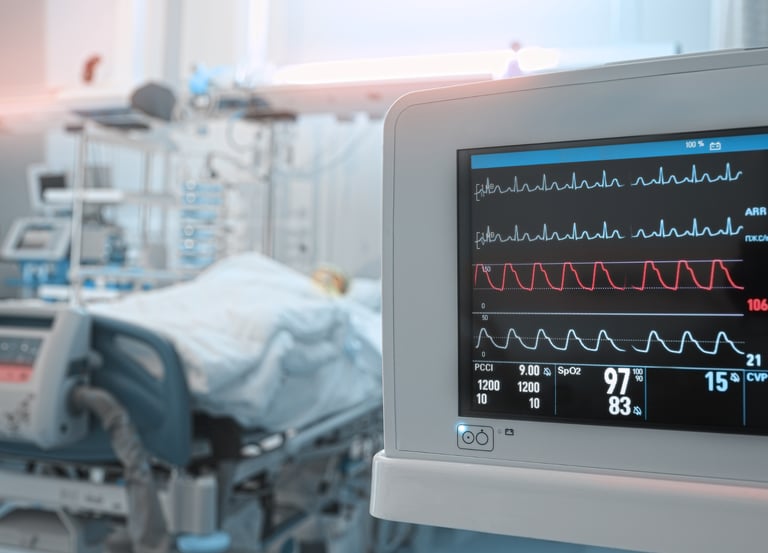
Monitors
Screens showing your loved one's heart rate, oxygen levels, and blood pressure in real time.
Alarms don't always mean danger... they simply signal the nurse to come and check.
Intravenous Lines (IVs)
Breathing Support
Multiple medications may be needed at once, requiring more than one IV line. Most are connected to a pump to ensure the right amount is delivered safely and steadily.
Oxygen support may come through a mask, tube, or ventilator. Ventilators look intimidating, but they simply help the lungs rest and heal at their own pace.

Equipments
Medications
Respiratory
Your Care Team
The ICU Team - everyone in the room
Every person on this team works together every single day to make your experience as good as it can be, despite the circumstances.
ICU nurses (at the bedside minute by minute), Medical doctors (aka intensivist), Nurse Practitioners, Medical residents/fellows (MD in speciality training), Respiratory Therapists, Pharmacists, Dieticians, Social Workers, Clinical Assistance/Team Attendants/Personal Support Workers, Unit Clerks
Fear
Fear often takes hold in the ICU. The unknown, the anxiety of tubes and wires, alarms ringing without explanation, and worry about what comes next. These feelings are completely normal.
YOUR EMOTIONS MATTER
It is okay to feel...
Every emotion you're experiencing right now is completely valid. Here's what many families go through, and how to move forward.
Confusion
Overwhelm
The ICU has its own language. You will encounter terms that no one stops to explain. Fortunately. nurses and doctors are always ready to rephrase information in a way that makes sense. Just ask.
Several physicians may arrive at once, each sharing updates very quickly. Don't hesitate to ask them to slow down. Jot notes so you can formulate questions later, when you have had some time to think.

You are not alone in this room. Every person on the ICU team, from the nurse at the bedside to the social worker, is there for your family too.
STEP - BY - STEP SUPPORT
Looking for a guided walkthrough?
The full ICU Guide covers everything - clearly, calmly, and without the jargon, and if there are any jargon attached is the explanation.
Fear
I must confess fear often takes hold of you in the ICU. It's the fear of the unknown, the anxiety of seeing tubes and wires connected to your loved one, the unsettling sound of alarms ringing without understanding their significance, and the worry about what might come next. these feelings are completely normal.
It Is Okay To Feel...
Confusion
One of the most confusing aspects of the ICU is its unique language—you're likely to encounter a lot of ICU “lingo” that isn't explained to you. Fortunately, both the nurses and doctors are always ready to rephrase information in a way that makes sense to you if you ask.
Overwhelm
You might experience a feeling of overwhelm as events unfold. Nurses and doctors are rushing about, and several physicians may come in to share updates, which can make it difficult for you to absorb all the information. In that moment, don’t hesitate to ask the healthcare provider to slow down (if possible) so you can jot down what they are saying. This will enable you to review the details later and formulate any clarification questions you may have.
Looking for step-by-step support
Empowering patients and families through nurse-led insights and the Akin companion app.


Contact
My Health Guide Hub and the Akin app provide educational and organizational resources to patients and those that support them. This is information, not medical advice. Use of this site or the app does not establish a nurse-patient relationship. Always consult your medical team for clinical decisions.